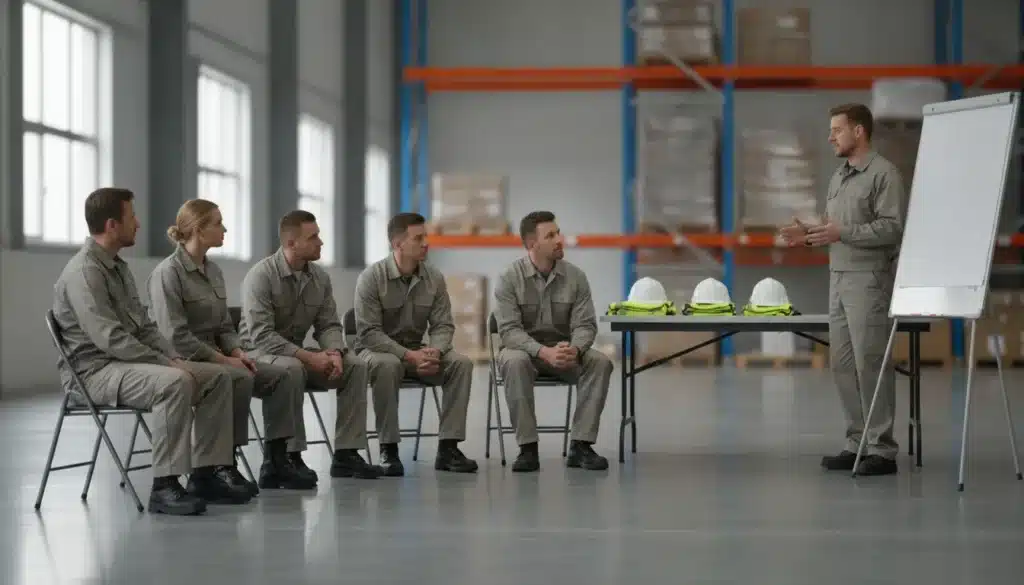
A warehouse orientation Houston job seekers attend is the meeting after a start is set and before you touch freight. It is not the job interview, and it is not a promise that the assignment will last. Use the time to confirm your shift, pack what the site asks for, and learn the safety rules for that building.
Call (281) 890-2220 if your start details are unclear. You can also search warehouse jobs if you still need a role.
What a warehouse orientation in Houston is for
Orientation is the first-day briefing at the warehouse, or sometimes at the staffing office before you go to the site. A supervisor or trainer covers the building rules, your shift, and how to report a problem. You may sign forms, get a badge, and walk the floor. You should not be sent onto a forklift or a pick line before that talk.
OSHA says the staffing agency and the host warehouse share training for temporary workers. Training should happen before the work starts, in words you understand. The warehouse is usually the one that teaches site hazards. The agency still has to check that the training happened. NIOSH describes the same heat risk on its page about workplace heat stress, which matters on a Houston dock.
TPI Staffing is a Texas staffing firm with a Houston focus. Recruiters place people into light industrial staffing, including warehouse roles, from the Cypress office and the Spring office. TPI does not place remote or work-from-home jobs of any kind. If a text offers warehouse pay you can do from your couch, treat that message as a scam and call the office before you click a link.
Confirm the details before you leave home
The night before, write down what your recruiter or the site contact told you, and do not fill blanks from memory. A wrong gate or a missed drug-screen window can cost you the start.
- Start time, shift length, and whether day one is orientation only or orientation plus work.
- Exact address, gate, and door. Houston sites often sit off a freeway frontage road, not at the mailing address.
- Who to ask for, and a phone number if you are running late.
- Dress code, closed-toe shoes, and whether the site provides a vest, hard hat, or badge.
- Whether you still owe a background check or drug screen. TPI runs those checks with legal compliance. The result is reviewed case by case. It is not an automatic yes or no.
- Parking rules and whether you need a ride share drop-off point.
If any line is blank, call your recruiter before you drive. The job placement steps are apply, connect, qualify, then get hired. Orientation sits after those steps, and it is not a second application you have to pass.
What to bring, wear, and leave at home
Pack light. Most warehouses will not let you keep a big bag on the floor. A clear plastic bag is a common rule, but ask your site. The application checklist already covers resumes and work history, so this day is different. Bring proof you are the person they hired, plus what you need to work a shift if they ask you to stay.
| What to handle | Bring this | Leave this at home |
|---|---|---|
| Proof of who you are | A photo ID that matches the name on your application. | Extra credit cards and loose cash you will not need. |
| Your start details | The recruiter’s name, the start time, and the site phone number. | Headphones, a speaker, or anything that makes noise on the floor. |
| Footwear | Closed-toe shoes you can stand in for a full shift. | Slides, and steel-toe boots unless the site asked for them. |
| Clothing | Plain layers that work on a hot dock or in a cold room. | Drawstrings, scarves, and jewelry that can catch on equipment. |
| Food and drink | Water and a small snack in case the break room is closed. | Glass bottles, if the site says they are not allowed inside. |
| Paperwork and guests | Any forms your recruiter already sent you to sign. | A friend or child, because most sites will not admit a guest. |
Wear clothes you can bend and walk in, tie long hair back, and keep your phone on silent. If the site issues a vest, put yours on before you enter the floor, not after someone has to stop you.
How to get there on time in Houston
Leave early. A 20-mile drive from Spring, Cypress, Katy, or The Woodlands can double in morning traffic on I-45, US-290, or the Grand Parkway. Build in time for a guard shack, a visitor lot, and a walk from the fence to the training room.
- Map the pin your recruiter sent, not a generic company name.
- Plan to arrive 15 minutes early, because late arrivals often miss the safety talk and have to reschedule.
- Have your ID out before you reach the window.
- If the gate turns you away, call the recruiter from the lot. Do not drive to a different door and hope.
- Save the after-hours number only for a true emergency. Daytime questions go to your recruiter or the job-seeker line, 281-890-2220.
TPI walk-in offices are in Cypress and Spring. Orientation for the warehouse itself is usually at the client site, not at those offices. Ask which door you are using so you do not sit in the wrong lobby.
What the safety talk usually covers
Every building is different. A good orientation still hits the same ideas. Listen for the exits, the horn and light signals on forklifts, and where pedestrians are allowed to walk. Ask what to do if you see a spill, a damaged rack, or a pallet that looks unsafe to move.
You may hear about heat, lifting, and powered equipment. Heat is a real Houston issue on the dock in summer, so drink water on breaks and tell a supervisor if you feel dizzy. Do not try to tough it out and then pass out on the floor.
Powered equipment is not a free-for-all on day one. If you are not trained and authorized on a forklift, do not drive one because someone is busy. Struck-by incidents, falls, and unsafe lifting are the usual warehouse risks, and your site’s rules win over any general tip you read online.
You can also ask who to tell if you get hurt. Report it the same day to the site lead and to your TPI recruiter. Waiting until the next shift makes the story harder to sort out. TPI does not take over the warehouse’s duty to train you on that building’s hazards.
Questions worth asking before you clock in
You are allowed to ask. A short list beats nodding through a speech you did not follow.
- Where do I park, enter, and badge in tomorrow?
- Who is my lead, and how do I reach them if I will be late?
- What is the break and lunch rule on this shift?
- Which shoes, vest, and gloves are required, and which ones does the site hand out?
- Am I picking, packing, loading, or doing something else today?
- What should I do if a task feels unsafe?
- How do time clocks work, and who fixes a missed punch?
Write the answers down before you leave the room. The person who trained you may not be on your shift next week. If the answer is “we will tell you later” for shoes, parking, or who to call, get a name and a time. Do not invent a policy the site never gave you.
After orientation
If they ask you to stay and work, follow the lead you just met. If they send you home, confirm your next start time before you leave the lot. Text or email your recruiter that you finished, and note anything that did not match what you were told, such as a different shift or a missing badge.
An orientation is not a guarantee of hours, a pay rate, or a permanent job. Temp and temp-to-hire assignments can change with the client’s needs. If the site is not a fit, tell your recruiter in plain words so they can look at other openings. They cannot promise the next one.
A simple plan for the day before
Do this the evening before, not in the parking lot. It takes about twenty minutes and saves a rough morning.
- Read the start text or email again. Copy the address, time, and contact into a note you can open offline.
- Set two alarms, one for leaving and one for fifteen minutes before the start.
- Lay out closed-toe shoes and plain clothes, and check that nothing hangs loose.
- Put your photo ID, a pen, and any forms in a small bag you can carry in one hand.
- Charge your phone, then save the recruiter and the job-seeker line, 281-890-2220.
- Check the route at the time you will actually drive, because night traffic is not morning traffic.
- Plan a simple breakfast and water, since a long safety talk on an empty stomach is a hard way to start.
- Go to bed at a normal hour, because a new building plus a warehouse shift is tiring even when the work is light.
If something still feels unclear, call while the office is open. Cypress and Spring hours run Monday through Friday, from 8:00 a.m. to 5:00 p.m. After-hours help is 832-244-7473, and that line is for a real problem, not a question that can wait until morning.
What a normal first hour looks like
Sites vary, but the first hour often follows a pattern. Knowing it helps when the lobby is busy and nobody looks ready for you.
You check in with a guard or a lead. They match your ID to a list. If your name is missing, that is a paperwork miss, not a reason to argue. Call your recruiter and wait where they tell you to wait.
Next you sit for a short talk. Someone covers emergency exits, pedestrian lanes, and how to report an injury. You may watch a video, and you may sign a page that says you heard the rules. Read that page, and ask if a line does not make sense. Signing is not the same as saying you already know every machine in the building.
Then you may get a badge, a vest, or a temporary sticker. Clip it where the site showed you. Some buildings walk you to the floor after that, and others send you home and bring you back for the real shift. Both can be normal, so ask which one you are in before you try to clock in.
On the floor, stay inside the marked walkway. Make eye contact with equipment operators, but do not expect them to stop for a wave. Keep your hands out of the racking. If a lead says to stay put, stay put. Wandering off to see the job is how people end up in a travel lane.
How TPI fits into that morning
Your recruiter set the start, and the warehouse lead runs the floor that day. Those are different jobs, and mixing them up slows everyone down. TPI can explain the assignment, the screening that was requested, and who to call if the site turns you away. The host site teaches you its hazards, its clock, and its break rules.
The published path is simple, and it starts when you apply to a specific opening. If your skills match, a recruiter reaches out, often the same day, and you talk through the role. Screening can include a background check and a drug screen, handled in line with the law. The client may interview you, or may skip that step. After a yes, someone coordinates the start paperwork. None of that is a promise of hours or a permanent job.
Light industrial work includes warehouse tasks such as shipping, receiving, and general warehouse help. This article stays on orientation, so if you are still choosing which opening fits, read the posting itself. Do not treat these tips as a list of open jobs.
Spanish-speaking help is available at the offices. If you want the safety talk or the recruiter call in Spanish, say so before the start date. Do not wait until you are in a loud lobby.
If the day goes sideways
Some starts wobble for ordinary reasons. A gate list is wrong, a drug screen is still pending, or the shift on the board is not the shift in your text. Handle it in order so you do not make it worse.
- Stop where you are, and do not enter the floor to sort it out inside.
- Call your recruiter and say the problem in one sentence.
- Stay where security asked you to wait, or return to your car if they ask you to leave.
- Write down names and times, because a short note helps if you need a new start.
- Ask when to come back, and repeat the time so you both heard it.
If you feel sick, say so before you start lifting. Heat illness is common on a Houston dock, and hiding it helps nobody. If you are hurt, report it that day to the site and to TPI. If a task conflicts with the safety talk you just heard, ask the lead to show you the approved way.
A missed start is frustrating, but it is not a ban from every warehouse in the area. Tell your recruiter what happened, then look at other openings you can actually do. TPI does not recruit for engineering, IT, medical, construction, or day labor. Skip those listings and stay with light industrial and office work.
Still looking, or the start fell through? Go back to current listings rather than waiting on a text from a number you do not know.
Call (281) 890-2220 with a question about your start, or find jobs with TPI and apply to a specific opening.
Frequently asked questions
Is a warehouse orientation the same as the interview?
No. The interview is how a recruiter or the client decides whether to move you forward. Orientation happens only after a start time is already set. You use it to learn the building, the shift, and the safety rules for that site. Treat the two meetings as different days with different goals.
Do I get paid for warehouse orientation?
Ask your recruiter before you go, because pay rules depend on the assignment and on whether the site has you working after the talk. Do not assume the morning is unpaid, and do not assume a rate nobody put in writing.
What if I miss the start time?
Call your recruiter and the site contact as soon as you know you will be late. Many warehouses will not restart a safety talk for one person. Missing it can push your start to another day, and it does not mean you should walk onto the floor without the briefing.
Can I bring someone with me to orientation?
Plan to go alone. Warehouses rarely allow visitors past the lobby, and a guest can keep you out of the training room. If you need a ride, ask that person to wait off the property until you text them.
What if a text says it is TPI but asks me to click a link?
Do not tap the link or send personal details. TPI does not place remote warehouse jobs. Call 281-890-2220 and ask if the message is real. Block the number if the office says it is not.