Assembly jobs Houston applicants ask about are usually plant jobs, not office jobs. You put parts together, check that the piece is right, and keep your station clean.
The U.S. Bureau of Labor Statistics says assemblers and fabricators build finished products and the parts that go into them. Most of that work is full time in a manufacturing plant, with some evenings and weekends. A high school diploma is enough for many roles. Advanced work asks for more experience and training.
That national picture is a starting point. The shift, the tools, and the product still depend on the Houston employer. Here is what to look for before you apply:
- The daily work is matching parts to a print, building them, and checking the piece.
- Shifts, weekends, and overtime are set by the plant, not by one company-wide schedule.
- Temporary and temp-to-hire are the usual models. Neither one promises a permanent job.
Call 281-890-2220 to talk with a TPI Staffing recruiter about assembly work, or search open jobs and apply online.
What Assembly Jobs Houston Work Actually Looks Like
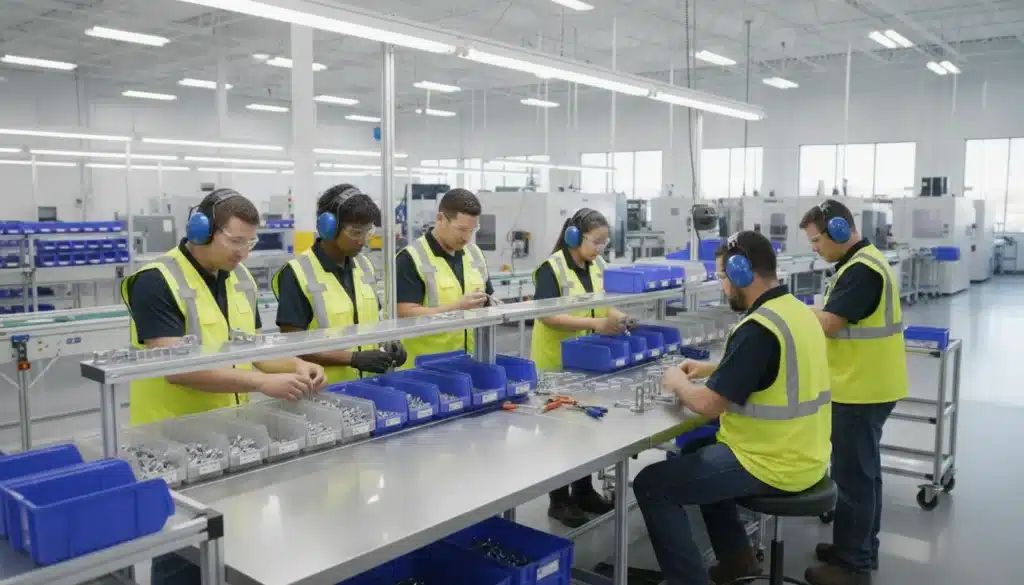
On a typical day you are building something a customer will use or a part that goes into a larger product. The Bureau of Labor Statistics lists the usual duties in plain steps. You read schematics and blueprints. You line up components by hand or with a hoist. You use hand tools or machines to put parts together, run quality checks, and clean the station and the tools. In a Houston plant that can mean a bench with bins of hardware, a short moving line, or a cell where one person finishes a subassembly before it moves on.
The work is more specific than “put things together.” You match a part to a print or a sample. You seat a fastener until it is tight, not until it feels close. You look for a scratch, a missing clip, or a part that will not sit flush. Then you set the finished piece in the right bin so the next person is not guessing. Some stations are almost all hands. Others use air tools, a press, or a simple fixture that holds the part still.
TPI Staffing recruits for this kind of light industrial work as part of its assembly staffing expertise, alongside manufacturing, warehouse, and skilled-trades roles. The industrial page names assembly as its own specialty, from general labor through specialist work that keeps a line moving. That is the family of jobs this guide covers. It is not engineering design, IT, medical device clinical work, construction, or day labor.
Bench work versus a moving line
Bench assembly usually means you stay at one station and finish a set of steps before the part leaves you. A moving line means the part comes to you on a timer and you do one or two steps before it moves. Both show up around Houston. Bench work can be better if you like owning a whole small build. Line work can be better if you like a clear, repeated step and a set pace. Ask which one the order uses before you say yes. The pace, the standing time, and the chance to sit are not the same.
Quality checks are part of the job, not a separate department you never see. The Bureau of Labor Statistics notes that assemblers look for faulty components and mistakes in the build. On the floor that can be a visual check, a gauge, a torque check, or a simple go/no-go fixture. If you spot a bad part, the useful move is to stop, set it aside, and tell the lead. Shipping a bad piece to look fast usually creates more work later.
Where Houston Assembly Work Happens
Most of this work happens inside a plant, not in a home office and not on a construction site. TPI Staffing does not place remote or work-from-home positions. Virtual recruiting only means a recruiter can talk with you by phone or video. The assignment itself is on site. Expect a building with overhead lights, marked aisles, part bins, and a clock-in point. Some floors are climate controlled. Some are warm, especially in a Houston summer, so heat and hydration matter even indoors.
Products vary. Houston-area assembly can sit next to fabrication, electronics, distribution, oil and gas support, or general manufacturing. TPI Staffing’s industrial page lists fabrication and manufacturing, electronics, production, and distribution and logistics among the industries it supports. A solar-panel or related manufacturing line is another setting the company recruits for. You might build a metal bracket one week and a small electronic subassembly another week. The setting changes the tools and the cleanliness rules. It does not change the core habit: follow the print, keep the station tidy, and flag anything that does not match.
Two offices cover the tight local area. Cypress is at 21840 Northwest Freeway, Suite E, Cypress, TX 77429, and that office also recruits for Katy and Tomball. Spring is at 322 Spring Hill Dr, Suite A100, Spring, TX 77386, and that office covers North Houston, The Woodlands, and Conroe. Business hours are Monday through Friday, 8:00 a.m. to 5:00 p.m. Central. If you already live in that radius, say so. TPI Staffing is looking for people who are already in the Houston area, not people planning a move from out of state.
You can walk in during those hours or start online. The Cypress staffing office and the Spring staffing office both take job seekers. Pick the office closer to the commute you can actually keep. A great shift across town that you cannot reach by 6 a.m. is not a great shift.
Shifts, Pace, and What to Ask Before You Accept
Assembly schedules are set by the plant, not by a single company-wide template. A local electronic-assembly schedule might run four weekdays, for example Monday through Thursday from about 7:00 a.m. to 5:30 p.m., with Friday or Saturday overtime only if that plant asks for it. A mechanical-assembly schedule might use 8- to 12-hour shifts, including an early window such as 6:00 a.m. to 2:30 p.m., and some plants ask for weekends. Those are examples of how a schedule can be written, not a live posting. Check the jobs board for what is open today.
The Bureau of Labor Statistics says most assemblers work full time, including some evenings and weekends. On a Houston floor that often means first shift starting early, a second shift that runs into the evening, or a weekend crew that covers overtime. Four 10-hour days are common when a plant wants a long weekend. Five 8-hour days are common when the line runs steady all week. Overtime is a plant decision. Do not assume it, and do not assume you can refuse it if the order says it is required.
| What to confirm | Why it changes the job | What to ask the recruiter |
|---|---|---|
| Start and end time | A 6:00 a.m. start is a different life than a 3:00 p.m. start. | What time does the shift begin and end, including breaks? |
| Days and weekends | Some orders are four weekdays. Others need Saturday. | Which days are required, and is weekend work expected? |
| Overtime | Extra hours can help a paycheck and wreck a second commitment. | Is overtime optional, or is it part of the order? |
| Standing or sitting | A bench stool and a moving line do not feel the same after eight hours. | Will I stand most of the shift, or is a stool part of the station? |
| Assignment length | Temporary coverage and a temp-to-hire trial are not the same plan. | Is this temporary, temp-to-hire, or a direct-hire search? |
Pay is set per order. TPI Staffing does not publish a single assembly rate, and this guide will not invent one. Nationally, the Bureau of Labor Statistics reported a May 2025 median of $21.85 an hour for assemblers and fabricators. That is a U.S. median, not a Houston offer and not a TPI Staffing bill rate. Your offer, if you get one, will name the hourly pay for that assignment. Ask about it on the phone screen instead of guessing from a job board ad.
Pace is the other number people forget to ask about. A line with a set cycle time feels different from a bench where you finish a kit and then start the next one. If you have worked a fast pack line, say so. If you have only done slower bench builds, say that too. A recruiter can match you better when the pace is honest.
Skills and Physical Demands That Show Up on the Floor
You do not need an engineering degree. The Bureau of Labor Statistics says a high school diploma or equivalent is the typical entry education. Related work experience is not required for the occupation as a whole. Training is usually moderate-term and happens on the job. Houston employers still sort people by what they have already done. Two years on small parts, soldering, or mechanical assembly will open more doors than a blank application. Entry-level orders exist. They still expect you to follow a process and show up on time.
Skills that transfer well:
- Reading a simple print, a work instruction, or a sample part and matching your build to it.
- Using hand tools, torque tools, or air tools without forcing a part that does not fit.
- Working with small hardware and keeping left and right, or top and bottom, straight.
- Checking your own work before you pass it on.
- Standing, reaching, and repeating the same motion for most of a shift.
- Wearing safety glasses, hearing protection, gloves, or steel-toe shoes when the plant requires them.
- Telling a lead when a part is wrong instead of hiding it in the good bin.
Soldering, mechanical assembly, and comfort with small parts come up often on local orders. So does basic hand-tool experience from warehouse kitting, maintenance helper work, or a previous plant job. If your background is forklift or material handling, that still helps a plant that mixes assembly with warehouse support, but it is not the same as bench assembly. Say which one you have done.
The body of the job is repetitive. You may stand for long stretches or sit at a stool and lean over a bench. The Bureau of Labor Statistics flags both. Shoulders, wrists, and feet are the usual complaints. Good shoes, a station set at the right height, and speaking up about a fixture that forces a bad reach all matter. OSHA treats safety for temporary workers as a shared duty between the staffing firm and the host employer. TPI Staffing’s clients can ask its HR team about forklift safety, heat safety, and new-hire onboarding. That does not replace the plant’s own rules. Follow the host site’s training, and do not start a task you have not been shown.
Steel-toe boots, safety glasses, and hearing protection are common. Some plants provide them on day one. Some expect you to bring boots. Ask before the first morning so you are not turned away at the door.
Temporary, Temp-to-Hire, and Direct Hire
Assembly orders at TPI Staffing usually fall into one of three models. The label changes who employs you on day one and what “permanent” means later. None of them is a promise that you will be hired, kept, or converted.
Temporary means TPI Staffing recruits you for an assignment with a client. You cover a season, a surge, or a short vacancy. The assignment has an end unless the client extends it. Pay, shift, and any screening are confirmed on that order.
Temp-to-hire means you work the assignment first so the client can see the work before deciding on a permanent hire. There is no published trial length, conversion fee, or automatic switch to the client’s payroll. Many clients like this model because they can watch the work. You should still ask how long the assignment is expected to run and what the client looks for before a conversion talk.
Direct hire means recruiters source a full-time employee for the client. TPI Staffing says those searches can take from two weeks up to three months, depending on the client’s process. That range is not a start-date promise. Direct hire is a smaller part of the business than temporary and temp-to-hire light industrial work. If a posting says contract or contract-to-perm, read it as temporary or temp-to-hire until a recruiter tells you otherwise.
Basic job placement through TPI Staffing does not charge you a fee. Optional resume writing and interview coaching are separate, paid services, and you do not need them to be considered. Benefits such as medical, dental, and vision, direct deposit, and paid holidays are listed for employees, but eligibility depends on the assignment. Do not assume every short assignment includes every benefit.
How TPI Staffing Screens Assembly Applicants
TPI Staffing publishes two views of the same path. The job-placement page is the short version for candidates: apply, connect, qualify, then get hired. The employer page lists the longer screen. It includes an individual interview, a look at your resume, and a skills review. It can also include online skills testing, a criminal background check, and drug testing when someone is selected for assignment. References and education checks are on that list too. The client can then interview you in person, by phone, or skip that interview. After a selection, TPI Staffing coordinates onboarding paperwork.
Use the placement-page sequence as your checklist:
- Application. Apply to a specific opening on the jobs board. The job placement steps explain what happens after you apply. Those applications go to a recruiter with the role attached. A general profile is a different path. If you are chasing one assembly order, use the job application.
- Phone interview. If your skills match an open order, a recruiter reaches out to schedule a call. There is no published response time, so do not plan on a same-day callback. Have your shift limits, commute, tools you have used, and pay needs ready when you apply.
- In-person interview. Some orders add a conversation at the Cypress or Spring office, or a client interview at the plant. The client can also choose a phone interview or skip the client interview.
- Skills assessment. Recruiters review your work history and can use skills testing. TPI Staffing says it has more than 1,000 online assessments, aimed mainly at professional, semi-professional, and office skills. A plant order may instead be a hands-on check or a talk about the tools you have used. Not every assembly order includes a formal test.
- Background check. The temporary-staffing page says TPI Staffing runs a criminal background check through its HR department before hiring and reviews results case by case, in line with EEOC and FCRA rules. A record is not an automatic no.
- Drug screen. TPI Staffing can run a pre-employment multi-screen drug test for people selected for assignment. It is not described as a test for every applicant, and the cost can vary. Screening follows applicable law.
A start date depends on the order, the screen, and the plant. There is no published timeline, and a fast start is not something to count on. Listings also change. If a link says the position is no longer available, apply to a current opening or send a resume anyway so a recruiter can look at other assembly orders. Do not treat a closed posting as an open job.
Bring a simple work history: employers, dates, the tools you used, and whether you stood or sat. If you have soldering, mechanical assembly, or small-parts experience, put the years on the application. If you do not, say what you did do, such as kitting, machine helper, or quality checks. Gaps are easier to explain in the phone interview than to leave blank.
How to Get Ready for the First Week
Before the first shift, confirm four things with the recruiter. Get the address, the start time, the safety shoes or glasses you must bring, and the name of the person you report to. Houston traffic and a 6:00 a.m. gate do not leave much room. Do a practice drive if the plant is new to you. Cypress, Spring, Tomball, Katy, The Woodlands, and Conroe are all inside the area these offices cover. South Houston is not the focus.
On day one, expect to clock in, meet a lead, and learn one station before you learn the whole floor. Listen for the quality rule and the stop rule. Ask where bad parts go. Ask what “done” looks like on that print. Keep your phone away unless the plant allows it. If something feels unsafe, stop and tell the lead. Heat, forklifts moving through aisles, and pinch points on a press are the usual hazards, and the host employer sets the training for its building.
If the assignment is temp-to-hire, treat the first weeks as the interview that happens while you work. Show up, hit the quality standard, and tell the recruiter if the shift you were promised is not the shift you are working. TPI Staffing can take assignment feedback after you start. Use it if the job and the order do not match.
We are an equal opportunity employer and consider all qualified applicants for employment without regard to race, color, religion, sex, pregnancy, sexual orientation, gender identity, national origin, age, disability, genetic information, veteran status, or any other status protected by applicable federal, state, or local law.
Employment decisions are based on qualifications, skills, and business needs.
Ready to see current assembly openings? Call 281-890-2220 or apply online.
FAQ: Assembly Jobs Houston
Do I need experience for assembly jobs in Houston?
Many orders prefer one to two years with small parts, mechanical assembly, or soldering. The occupation as a whole does not require related experience, and some orders are entry level. You still need to follow a work instruction and keep a steady pace. Tell the recruiter what you have actually done.
Are these jobs temporary or permanent?
Both exist. Temporary and temp-to-hire are the main light industrial models. Direct hire is a separate search for a full-time employee and can take longer. Temp-to-hire does not guarantee a permanent offer at the end of the assignment.
Will I stand all day?
Often, yes. Some benches include a stool. The Bureau of Labor Statistics notes long periods of standing or sitting. Ask about the station before you accept the shift.
Do I pay TPI Staffing to apply?
No. Basic recruiting and job placement do not charge the applicant. Paid resume help is optional and separate.
What if the job I clicked is closed?
Apply on the live board or call 281-890-2220. Closed posts stay online for a while. A recruiter can see whether a similar assembly order is open in Cypress, Spring, or nearby.